

Quick Navigation
My Encounter with the Unknown
Last month, I attended a lecture on exoplanetary science, where the speaker discussed the recent discovery of TOI-5205 b, a Jupiter-sized world orbiting a small, cool star. What struck me was the planet’s atmosphere, which is surprisingly poor in heavy elements – even less enriched than its own star. This finding defies current theories of how giant planets form, leaving scientists puzzled.
I’ve always been fascinated by space exploration and the mysteries it holds. As someone who’s worked with astronomy software, such as NASA’s Exoplanet Archive and ESO’s Archive Science Portal, I understand the complexity of analyzing exoplanetary data.
Challenging Common Assumptions
Most people think that the formation of giant planets is a straightforward process, with heavy elements accumulating in the planet’s atmosphere over time. However, TOI-5205 b’s atmosphere suggests that this might not always be the case. In fact, NASA’s James Webb Space Telescope has revealed that this planet’s atmosphere is more similar to that of its star than expected.
This challenges our current understanding of planetary formation and raises questions about the role of heavy elements in shaping a planet’s atmosphere. As Harvard University’s Dr. David Charbonneau notes, ‘The discovery of TOI-5205 b is a game-changer for our understanding of planetary formation and the diversity of exoplanetary atmospheres.’
A Deeper Look into the Data
To better understand the implications of TOI-5205 b’s atmosphere, let’s dive into the data. According to a study published in Nature, the planet’s atmosphere is composed mostly of hydrogen and helium, with minimal heavy elements. This is surprising, given that the planet’s star has a higher concentration of heavy elements.
Using tools like Python and Astropy, scientists can analyze the spectral data from the James Webb Space Telescope to gain insights into the planet’s atmosphere. By applying machine learning algorithms, such as those found in scikit-learn, researchers can identify patterns in the data that may have gone unnoticed otherwise.
Practical Applications and Future Directions
So, what can we learn from TOI-5205 b’s atmosphere? For starters, it highlights the importance of continued exploration and research into exoplanetary science. By studying the atmospheres of exoplanets like TOI-5205 b, we can gain a better understanding of the formation and evolution of planetary systems.
Furthermore, this discovery has implications for the search for life beyond Earth. If we can identify the conditions that lead to the formation of atmospheres like TOI-5205 b’s, we may be able to pinpoint planets that are more likely to support life. As SETI Institute’s Dr. Seth Shostak notes, ‘The discovery of exoplanets with unusual atmospheres is a reminder that the universe is full of surprises, and that the search for life beyond Earth is an ongoing and exciting journey.’
Conclusion and Future Research
In conclusion, the discovery of TOI-5205 b’s atmosphere is a significant finding that challenges our current understanding of planetary formation. As scientists, we must continue to explore and research the mysteries of the universe, using tools like the James Webb Space Telescope and machine learning algorithms to gain insights into the data.
For those interested in exploring exoplanetary science further, I recommend checking out Exoplanets.org and The Open Exoplanet Catalogue. These resources provide a wealth of information on exoplanetary discoveries and the latest research in the field.
FAQs
What is TOI-5205 b?
TOI-5205 b is a Jupiter-sized exoplanet orbiting a small, cool star. Its atmosphere is surprisingly poor in heavy elements, defying current theories of planetary formation.
How was TOI-5205 b discovered?
TOI-5205 b was discovered using the James Webb Space Telescope, which analyzed the planet’s atmosphere and revealed its unusual composition.
What are the implications of TOI-5205 b’s atmosphere?
The discovery of TOI-5205 b’s atmosphere challenges our current understanding of planetary formation and raises questions about the role of heavy elements in shaping a planet’s atmosphere.
How can I learn more about exoplanetary science?
For those interested in learning more about exoplanetary science, I recommend checking out online resources like Coursera and edX, which offer courses and tutorials on astronomy and exoplanetary science.
What’s next for the study of TOI-5205 b?
Future research will focus on further analyzing the data from the James Webb Space Telescope and exploring the implications of TOI-5205 b’s atmosphere for our understanding of planetary formation and the search for life beyond Earth.
You Might Also Like
Written by George · The Curious Loop · Updated April 8, 2026
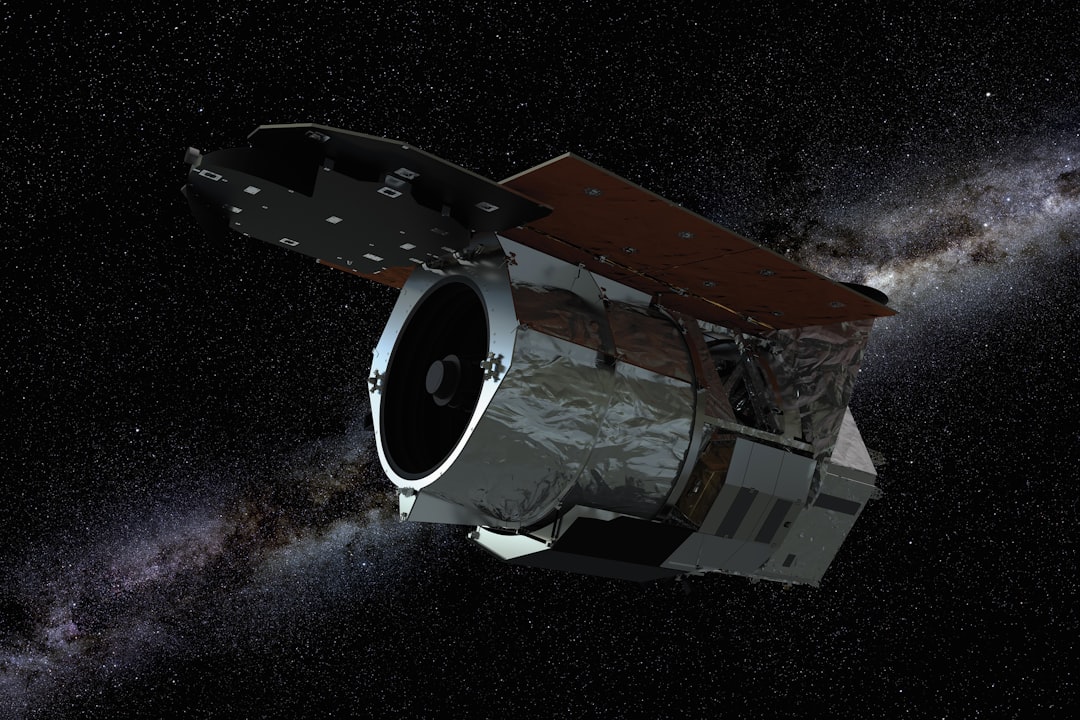
Photo by NASA Hubble Space Telescope on Unsplash
